Split Driver Expression Patterns
Split driver expression patterns in Virtual Fly Brain.
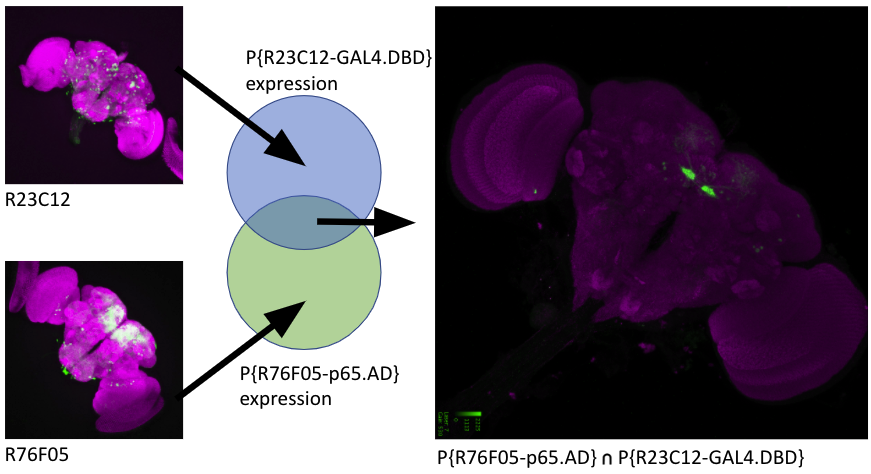
Split drivers comprise at least two partial transcription factors that can reconstitute an active transcription factor when expressed in the same cell. By using different regulatory regions for each component, functional driver expression can be restricted to the intersection of the expression patterns of these regulatory regions. A wide range of regulatory regions have been combined with transcription factor DNA binding domains (DBDs) and Activation Domains (ADs) to form thousands of distinct constructs, referred to as hemidrivers. Millions of combinations are therefore possible, each targeting some precise subset of the many thousands of neurons in the Drosophila nervous system.
Finding the useful ones is the hard part. The Janelia resource reports 3,060 cell-type-specific split-GAL4 lines for the adult CNS and 1,373 characterised in third-instar larvae, identified by examining over 77,000 split combinations between 2013 and 2023 (Meissner et al., 2025). For the underlying method see binary expression systems.
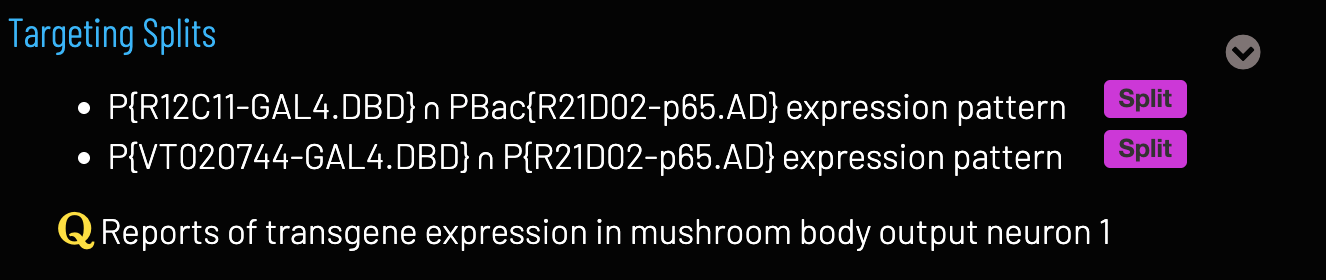
Researchers can identify split drivers for neurons of interest from the Targeting Splits section of a cell type Term Info page or by using similarity scores from a single neuron image. It is also possible to search directly for particular hemidrivers and combinations.
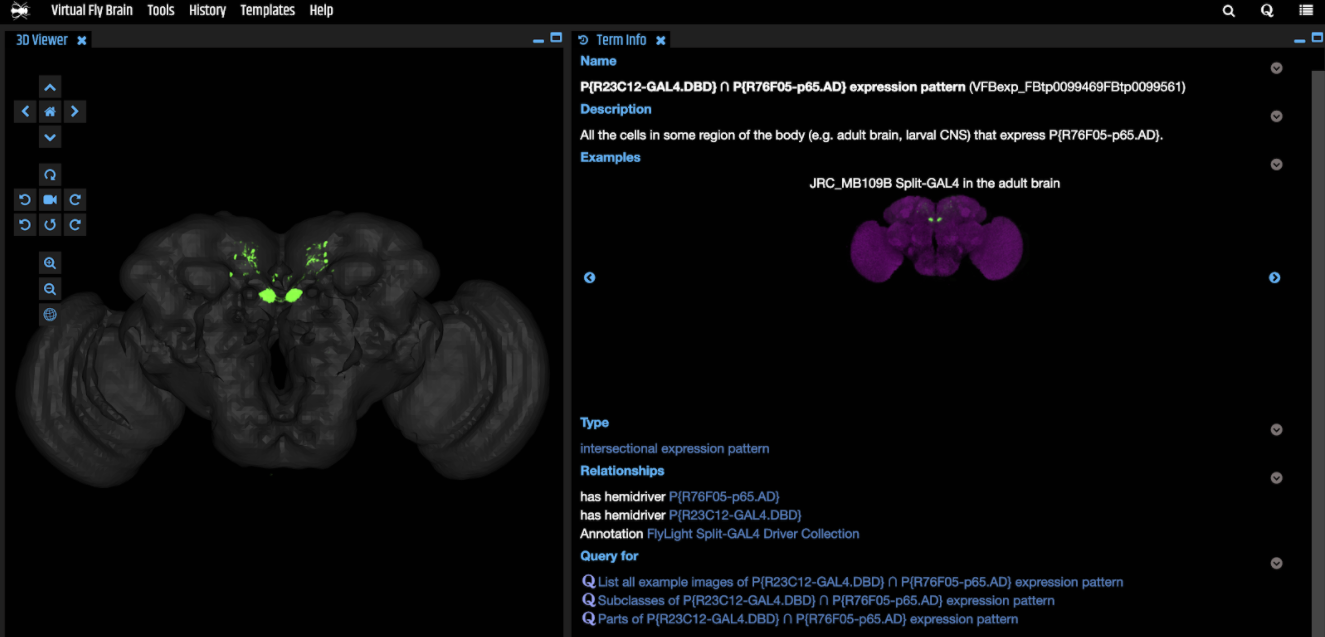
Similar to non-split drivers, VFB contains images and curated information about expression patterns for combinations. Each combination gets a standard name in VFB, reflecting the names of the component hemidrivers and any short names for the combination from the literature are added as synonyms (e.g. “P{VT017411-GAL4.DBD} ∩ P{VT019018-p65.AD} expression pattern” has_exact_synonym: SS02256").
To obtain flies, use Find fly stocks on the expression pattern’s Term Info page. It looks up the FlyBase combination (FBco) for the two hemidrivers and lists stocks that carry the whole combination. Where none exist, it lists stocks of each hemidriver instead, so the split can be built by crossing. See the queries reference for details.
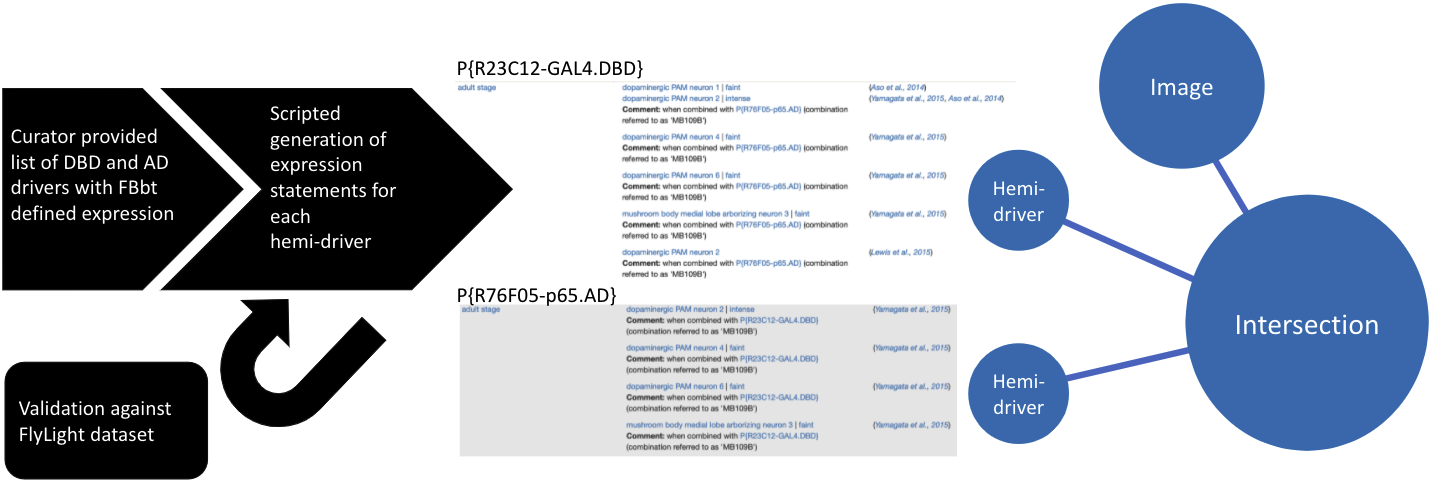
VFB curation uses programmatic methods to generate expression statements for FlyLight hemidriver combinations. Combinations are validated against a local copy of the FlyLight dataset and loaded into FlyBase. VFB then links each expression pattern image and the curated expression information to an intersection of the two appropriate hemidrivers.